
Last updated: 14 March 2026
Definition
Most broadly speaking, unexploded ordnance, or UXO, are objects of an explosive nature — such as mortar rounds, grenades, cluster bombs, and even bullets — that for mechanical reasons failed to explode at their intended and initial time of use, thereafter continuing to pose a dangerous and uncertain risk of detonation. A related term is Explosive Remnants of War (ERW), that includes both UXO as well as “abandoned ordnance” such as landmines and Improvised Explosive Devices (IEDs), that are functioning properly but were left behind after a military existed a zone of conflict and have simply not yet been activated1. The fundamentally unique danger of UXO is that they continue to indiscriminately kill and maim for innumerable decades after a conflict has ended, serving as a perpetual reminder and ever-living force of violence to hold back a community’s hopes for recovery and peace. For this reason numerous international movements have pushed for total and partial bans on the use of certain particularly problematic UXO varieties, including in the United Nations Convention on the Prohibition of the Use, Stockpiling, Production and Transfer of Anti-Personnel Mines and on their Destruction that entered into force March 1999, and the Convention on Cluster Munitions that entered into force August 2010.2 Unfortunately, many of the world’s greatest powers including China, Russia, and the United States are yet to become party to these conventions, therefore remaining unbound by the specific laws they set forth.3
Global Presence
The exact number of countries currently contaminated with UXO and landmines is difficult to determine. The following map shows the 48 countries where the top three international demining organizations currently operate — Halo Trust, Mines Advisory Group (MAG), and United Nations Mine Action Service (UNMAS).

This may be compared with the following two maps, that specifically show global contamination levels of cluster munitions (25 countries) and landmines (36 countries) respectively.


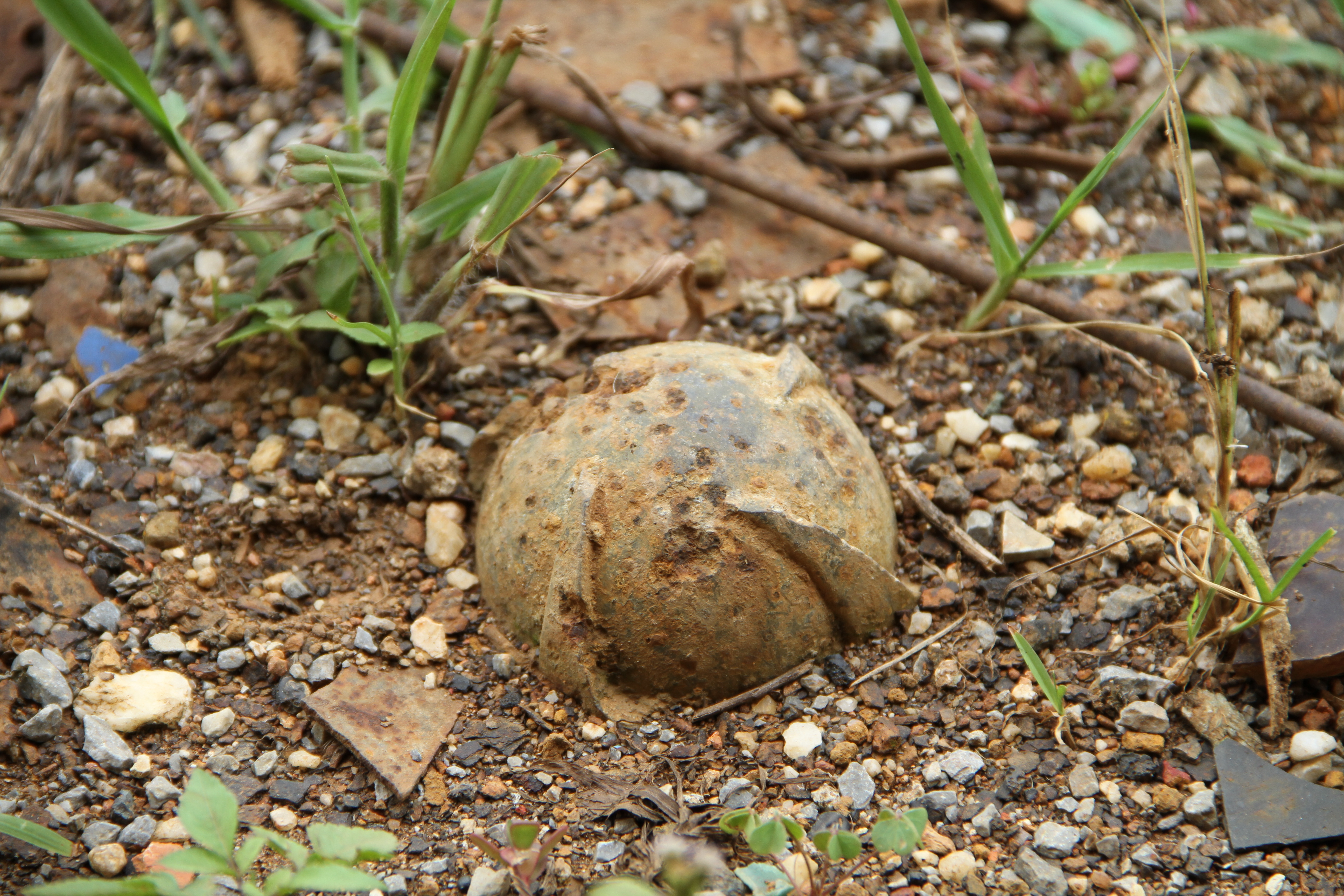
One of the most infamous cases of UXO contamination is in Southeast Asia, specifically the countries of Cambodia, Laos, and Vietnam, with Laos alone bearing the unenviable title of “most bombed country in the world” per capita.4 The ordnance footprint is largely composed of spherical submunition “bomblets” 64mm in diameter, the BLU-26 model “by far the most frequently used”,5 that were dropped by the United States approximately 670 at a time in larger dispenser bombs (e.g. SUU-30) that would scatter them over an area of around 0.5 hectares (1.2 acres) or more.6 Each of these cluster bombs contains approximately 300 6mm steel balls that fly out upon explosion with a lethal radius of over 5 meters (5.5 yards).7 The bombing of Laos and Cambodia — both of whom the U.S. was never officially at war with (thus both bombing campaigns are commonly referred to as “secret wars”) — was conducted with the intent of disrupting North Vietnamese supply lines during the Second Indochina War. In total, from 1964 to 15 August 1973 6,162,000 tons of explosives were dropped over Cambodia, Laos, and Vietnam for a combined impact roughly equal to 100 times that of the atomic bombs used at Hiroshima and Nagasaki, with an estimated 30% failure rate in detonation upon striking the ground.8 For Laos, that calculates out to one plane-load of bombs every 8 minutes, 24 hours a day, for 9 years.9 The result is that after over 50 years and hundreds of millions of dollars in international aid,10 experts anticipate that in Laos alone cleanup will not be completed for over 200 years.11
However, if reviewing clearance data published by the government of Laos, considering that only around 636,000 cluster munitions were cleared from the ground between 2011 and 2020, assuming similar future performance through employing the same techniques and receiving the same amount of international aid12, and accounting for the nearly 968,000 cluster munitions destroyed since the formal beginning of UXO clearance operations in 1996 up to 2022, the timeline for Laos being virtually cleared of cluster munitions is closer to 1,240 years — and this is not taking into account the innumerable UXO/ERW outside of the 80 million that are not cluster munitions.13 Similarly, the government of Laos estimates that from 1996 to 2022 only 0.83% of all contaminated land had been cleared; at this average of only 0.03% annual clearance over the 26-year period, 100% clearance would be reached after over 3,000 years.14 While 100% clearance is an unrealistic goal, and a good deal of contaminated land is not inhabited, it is still clear that 200 years is an extraordinarily ambitious and currently impossible timeline by all standards.15 In order to appreciate the enormity of the task to clear up the 80 million cluster bombs that were left contaminating Laos (a number over ten times it’s population in 2024), you may view this visualizer published by KOI.


While UXO are being gradually removed, every year hundreds of civilians, a large portion children, lose their lives and limbs to these pervasive indiscriminate threats. This skew in victim demographic is in large part due to the higher curiosity of children that leads them to interact with UXO believing them to be toys, particularly so in the case of spherically shaped cluster bombs. Consequently, the most common injuries in children occur in correlation with them handling an explosive, including damage to or loss of the hands, facial and ocular injuries, including blindness, as well as deafness.18 While precise annual casualty statistics are difficult to come by across countries, the following captures a general picture of the current global situation. Note that the real casualty numbers are most certainly far higher than reported and recorded, due to lack of transparency, weakness in national recording mechanisms, lack of international cooperation, and other factors.
- Afghanistan — Current average of 50 civilian deaths per month from explosive devices. 89% of all ERW-related casualties from January 2023 to August 2024 were children.19
- Cambodia — 65,005 ERW and mine-related casualties between 1979-2022, 58% fatality rate for recorded cases. Average of 57 annually recorded incidents from 2018-2022, with victim demographics being 82.9% civilian (29.3% children), 7.3% military, and 9.8% deminer out of 41 total cases in 2022.20
- Chad — Average 34 annual ERW and mine-related casualties from 2019-2023. 26.5% fatality rate for 2023, or 9 out of 34 cases.21
- Iraq — Annual average of 165 ERW/mine-related casualties from 2019-2023. In 2023 there were 102 reported incidents with 39 (38.2%) ending fatally, and 35.6% of total known victims that year being children.22
- Laos — 50,966 ERW/mine casualties from 1964 to 2023. 38 annual casualties from 2019-2023. 23.4% fatality rate in 2023 (11/47), with 46.8% total casualties being children (22/47).23
- Mauritania — 642 recorded ERW/mine casualties between 1999-2023, with an annual average of 4 cases from 2019-2023. The fatality rate in 2023 was 25% (2/8).24
- Myanmar — 7,177 recorded ERW/mine casualties 1999-2023, with an annual average of 511 from 2019 to 2023. In 2023 there were 1,003 casualties, with a fatality rate of 22.8% and child casualty rate of 19.6% out of all recorded instances.25
- Sri Lanka — 1,719 recorded ERW/mine casualties from 1985 to 2022 (reality likely much higher), with an annual average of 5 from 2018-2022 and a 11.8% fatality rate in recorded cases. Out of 3 recorded cases in 2022 1 involved a child, with 100% of victims being civilians.26
- Syria — From 2011 to 2023 there were at least 12,871 casualties from ERW/mines, with a 48.9% fatality rate (6,295). Between 2020 and 2023 there was an annual average of 1,630 casualties. In total at least 4,445 recorded cases in Syria involved cluster munitions (2,236 from attacks, 2,209 from remnants). From antipersonnel mines alone, from 2011 to 2024 3,471 civilian casualties were recorded, with 919 (26.5%) of them involving children. In December 2024 UNICEF reported 116 child casualties from ERW that month.27
- Thailand — Annual average of 15 ERW/mine-related casualties from 2019 to 2023, with a 14.8% fatality rate (4) in 2023 out of 27 cases, involving a total of 11.1% civilians (3), 74.1% military personnel (20), and 14.8% deminers (4).28
- Türkiye — 6,857 recorded ERW/mine casualties from 1984 to 2022, with a 20.3% fatality rate. In 2019 there were 62 recorded incidents, although 52 (83.9%) involved IEDs rather than UXO or ERW. 24 total cases in 2019 (38.7%) involved civilian victims.29
- Ukraine — 1,379 ERW/mine-related civilian casualties reported by UN from 24 February 2022 (start of Russian invasion) to December 2024, with a fatality rate of 29.9% (413). Out of the total 40,838 civilian casualties since the start of the war (not specific to explosives), 2,502 (6.12%) have been children.30
- Vietnam — From 1975 to 2007 UXO brought about over 105,000 civilian casualties, with more than 38,000 (36.2%) resulting in death. Between 2013 and 2018 there was an annual average of 363 casualties, with nearly a 55% fatality rate. Approximately 23% of these incidents have occurred in Vietnam’s central provinces, such as Quảng Trị, that are the most highly contaminated (up to 84%), having been bombed by roughly 700 tons of explosives on a daily basis during certain periods of the war.31
These statistics represent officially cited figures, and are intended to provide an image of the current global situation without being entirely precise. As this data shows, the exact source of casualties — whether due to cluster munitions, landmines, IEDs, or other ERW such as mortar rounds — are most often not specified. This makes it difficult to discern precisely how many casualties may be traced back to UXO, and how many are due to other unique and problematic forms of explosives. Whether the data exclusively reflects civilian casualties or is inclusive of military incidents as well is also not always clear. In the case of cluster munitions, we may draw upon slightly more particularized datasets to conclude that Laos, Syria, Iraq, Vietnam, and Ukraine have likely suffered the highest number of cluster munition-related civilian casualties in global history.32
Effects on Development
UXO contamination poses a critical obstacle to a country’s development. As the United Nations Development Programme reported:
The presence of UXO hinders a community’s ability to safely cultivate land, which affects income generation and food security. It also limits access to education, health care and clean water, and presents an obstacle to building roads, supplying electricity, linking to commercial centres, or developing tourism.33
Two-thirds of all globally designated Least Developed Countries have gone through armed conflict in recent history, and UXO are perhaps the most direct contributor to prolonging this by indefinitely extending the effects of conflict into a country’s future.34 Underdevelopment leads to poverty, that itself may become an exacerbating factor in unsettling a country’s civil stability,35 meaning that UXO not only have a hand in prolonging effects of past conflicts, but may also contribute to nurturing the emergence of additional societal frictions that in time mature into fresh conflicts.36 This is not merely a matter of concern for countries contaminated with UXO, but it has been shown that such localized underdevelopment and instability brings widespread negative consequences that spill out to neighboring countries as well as leave a broader regional and global mark.37 Underdevelopment also limits a country’s ability to engage as an important contributor to bilateral and global initiatives — being recipients of aid rather than providers — in programs such as international peacekeeping, disaster relief, and climate protection. Development simultaneously makes countries more attractive targets for foreign investment, improving not only domestic but regional conditions as well.38
In many rural areas, farmers unable to let their land sit idle are forced to cultivate in fields known to be contaminated with UXO, and as a result often sustain serious injuries.39 Allowing land to sit unutilized threatens rural communities’ food safety and exacerbates the already direly impoverished income level.

Cam Lộ district, Quảng Trị province, Vietnam.40
- Up until a conflict has concluded and they are officially “abandoned”, landmines do not neatly fit into any one category and are therefore commonly referred to independently. The term “mine action” inclusively refers to humanitarian programs aimed at clearing and remediating risks associated with a variety of explosive ordnance utilized in war. ↩︎
- Please visit the United Nations Treaty Collection to view up-to-date information on these conventions. ↩︎
- Regardless of this, general principles of international humanitarian law such as distinction, proportionality, and military necessity still govern the use of weapons with a high threat risk to civilian populations. These principles derive from many sources and may be considered customary international law — thus applicable regardless of specific treaty obligations — most notably including the four Geneva Conventions and to an extent their three Additional Protocols. ↩︎
- “Where We Work: Laos,” The Halo Trust, https://www.halotrust.org/where-we-work/asia/laos/, accessed 25 November 2025. ↩︎
- “Visual Explainer: LAOS,” The Halo Trust, 28 February 2023, https://www.halotrust.org/news/laos-visual-explainer/. ↩︎
- Review of BLU-63/B Bomblet Program, Department of the Air Force, 14 January 1972, https://www.gao.gov/assets/b-173803.pdf, pp. 3, 40; Earl S. Martin and Murray Hiebert, “Explosive Remnants of the Second Indochina War in Viet Nam and Laos,” in Arthur H. Westing (ed.), Explosive Remnants of War: Mitigating the Environmental Effects, Stockholm International Peace Research Institute (Taylor and Francis, 1985), p. 45.
Note that the combination of the BLU-26 and SUU-30 was called the CBU-24 (“cluster bomb unit”). ↩︎ - Martin and Murray, Ibid. ↩︎
- Miguel, Edward and Roland, Gérard, “The long-run impact of bombing Vietnam,” (2010) 96(1) Journal of Development Economics, p. 2; Unexploded Ordnance (UXO) Sector Annual Report 2020, National Regulatory Authority for UXO/Mine Action in Lao PDR (NRA) (2021), p. 8. ↩︎
- Channapha Khamvongsa, “A Dramatic Effort to Address the Legacy of Bombing in Laos,” Open Society Foundation, 4 February 2014, https://www.opensocietyfoundations.org/voices/dramatic-effort-address-legacy-bombing-laos. ↩︎
- From 1993 to 2023, the U.S. had provided over $180 million in Cambodia, $310 million in Laos, and $185 million in Vietnam to support demining and related programs. “H.R.4570 — Legacies of War Recognition and Unexploded Ordnance Removal Act,” 118th Congress (2023), §2(a)(7). ↩︎
- Padriac Convery, “200 Years to Go Before Laos Is Cleared of Unexploded US Bombs from Vietnam War Era,” South China Morning Post, November 16, 2018, https://www.scmp.com/magazines/post-magazine/long-reads/article/2173220/200-years-go-laos-cleared-unexploded-us-bombs. ↩︎
- International funding for UXO removal in Laos and elsewhere has faced significant uncertainties, following the ninety-day freeze and subsequent cut to US foreign assistance in January 2025. Impacts of 2025 United States Funding Cuts on Humanitarian Mine Action, Landmine and Cluster Munition Monitor, accessed 23 April 2026, https://icblcmc.org/assets/monitor-factsheets/Factsheet-US-Funding-Cuts_Final-web.pdf. ↩︎
- National Regulatory Authority for the UXO/Mine Action Sector in Lao PDR (NRA), National Strategic Plan for the UXO Sector in the Lao PDR 2021-2023: “The Safe Path Forward III”, January 2023, https://nra.gov.la/resources/Strategy/SPF%20III%20Eng%20version%20on%2019.1.2023.pdf, p. 5, and appendix 5. ↩︎
- Ibid., p. 11. ↩︎
- Laos has a history of failing to meet its clearance quotas by a considerable amount; Ibid. ↩︎
- Review of BLU-63/B Bomblet Program, supra note 6 p. 4. ↩︎
- “USAF Bombing Data Map, Lao PDR,” National Regulatory Authority for UXO/Mine Action Sector in LAO PDR, https://www.nra.gov.la/resources/Map/Bombing_Map.pdf, accessed 30 November 2025. ↩︎
- Hugh G. Watts, “The Consequences for Children of Explosive Remnants of War: Land Mines, Unexploded Ordnance, Improvised Explosive Devices, and Cluster Bombs,” (2009) 2(3) Journal of Pediatric Rehabilitation Medicine, p. 224. ↩︎
- “Afghanistan,” UNMAS, https://www.unmas.org/en/programmes/afghanistan, accessed 29 November 2025. ↩︎
- The total number of cases with recorded fatality status from 1979-2022 is 50,962. In 2022 the total number of recorded child casualties was 12. “Impact: Cambodia,” Landmine and Cluster Munition Monitor, https://the-monitor.org/country-profile/cambodia/impact?year=2023, accessed 29 November 2025. ↩︎
- The all-time number of casualties is cited as 3,338 as of 2023, with no start date for the data. “Impact: Chad,” Landmine and Cluster Munition Monitor, https://the-monitor.org/country-profile/chad/impact?year=2023, accessed 29 November 2025. ↩︎
- Demographics of the victims was only recorded in 59 cases (57.8%), with 21 being children. The all-time number of casualties to 2023 is cited as 35,009, but the beginning year of the data is not provided. “Impact: Iraq,” Landmine and Cluster Munition Monitor, https://the-monitor.org/country-profile/iraq/impact?year=2023, accessed 29 November 2025. ↩︎
- “Impact: Lao PDR,” Landmine and Cluster Munition Monitor, https://the-monitor.org/country-profile/lao-pdr/impact?year=2023, accessed 29 November 2025. ↩︎
- “Impact: Mauritania,” Landmine and Cluster Munition Monitor, https://the-monitor.org/country-profile/mauritania/impact?year=2023, accessed 29 November 2025. ↩︎
- In 2023 the fatality status was recorded in 998 cases and demographics were recorded in 899. “Impact: Myanmar” (2023), Landmine and Cluster Munition Monitor, https://www.the-monitor.org/country-profile/myanmar-burma/impact?year=2023, accessed 29 November 2025. ↩︎
- The number of cases from 2018-2022 where fatality status was recorded were 17, with 2 fatalities. Sri Lanka is estimated to be contaminated with at least 1.6 million landmines. “Impact: Myanmar,” Landmine and Cluster Munition Monitor, https://the-monitor.org/country-profile/sri-lanka/impact?year=2023, accessed 29 November 2025. ↩︎
- “Impact: Syria,” Landmine and Cluster Munition Monitor, https://www.the-monitor.org/country-profile/syria/impact?year=2023, accessed 29 November 2025. ↩︎
- “Impact: Thailand,”, Landmine and Cluster Munition Monitor, https://www.the-monitor.org/country-profile/thailand/impact?year=2023, accessed 29 November 2025. ↩︎
- “Turkey: Impact,” Landmine and Cluster Munition Monitor, 21 April 2025, https://archives2.the-monitor.org/en-gb/reports/2022/turkey/impact.aspx. ↩︎
- Ukraine: Protection of Civilians in Armed Conflict December 2024 Update, United Nations Human Rights Office of the High Commissioner (December 2024), https://ukraine.un.org/sites/default/files/2025-01/Ukraine%20-%20protection%20of%20civilians%20in%20armed%20conflict%20(December%20%202024)_ENG_0.pdf, p. 3. ↩︎
- Simon Speakman Cordall, “Landmines Still Exacting a Heavy Toll on Vietnamese Civilians,” The Guardian, 18 September 2012, https://www.theguardian.com/world/2012/sep/18/vietnam-unexploded-landmines-bombs; “H.R.4570,” supra note 10, §2(a)(4); “Statistics of UXO Contamination in Vietnam,” Vietnam National Mine Action Centre, 5 January 2020, https://vnmac.gov.vn/en/tin-tuc/statistics-of-uxo-contamination-in-vietnam.t-61.html; Nick Turse, Kill Anything That Moves: The Real American War in Vietnam, (Metropolitan Books: 2013), p. 89. ↩︎
- Cluster Munition Monitor 2025, Cluster Munition Coalition, https://backend.icblcmc.org/assets/reports/Cluster-Munition-Monitors/CMM2025/Cluster-Munition-Monitor-2025-Web.pdf, accessed 29 November 2025, p. 52.
There exist specific numbers of cluster munition casualties per country, yet due to lack of transparency, weak national recording mechanisms, and other factors these statistics are known to fall far short of reality and are therefore of limited consultative value. ↩︎ - Beyond the Horizon: Reducing the Impact of UXO for Poverty Reduction in Lao PDR, United Nations Development Program (2012), https://www.undp.org/laopdr/publications/beyond-horizon-reducing-impact-uxo-poverty-reduction-lao-pdr, accessed 13 November 2025, p. 2. ↩︎
- 崔文星、黄梅波:《国际发展学概论》,复旦大学出版社2021年版,第199至200页。 ↩︎
- Ibid. ↩︎
- According to the United Nations, “[d]evelopment is the first line of defence against conflict.” “‘We Are Losing Ground’ in Preventing Conflict, Secretary-General Tells Security Council, Underlining Importance of Investing in Development,” United Nations, 19 June 2025, https://press.un.org/en/2025/sc16091.doc.htm. ↩︎
- Alberto Ades and Hak B. Chua, “Thy Neighbor’s Curse: Regional Instability and Economic Growth,” Journal of Economic Growth, Vol. 2, 1997. ↩︎
- Uk Heo and Terence Roehrig, South Korea’s Rise: Economic Development, Power, and Foreign Relations (Cambridge University Press: 2014), p. 11. ↩︎
- “Visual Explainer: LAOS,” supra note 5. ↩︎
- “Skadet (12788737223).jpg,” https://commons.wikimedia.org/wiki/File:Skadet_(12788737223).jpg, accessed 30 November 2025. CC By 2.0. ↩︎
Photo by MAG, CC BY 2.0.
.jpg)